What a 1:34 half marathon taught me about warming up, pacing, and why feeling amazing at mile one means almost nothing.
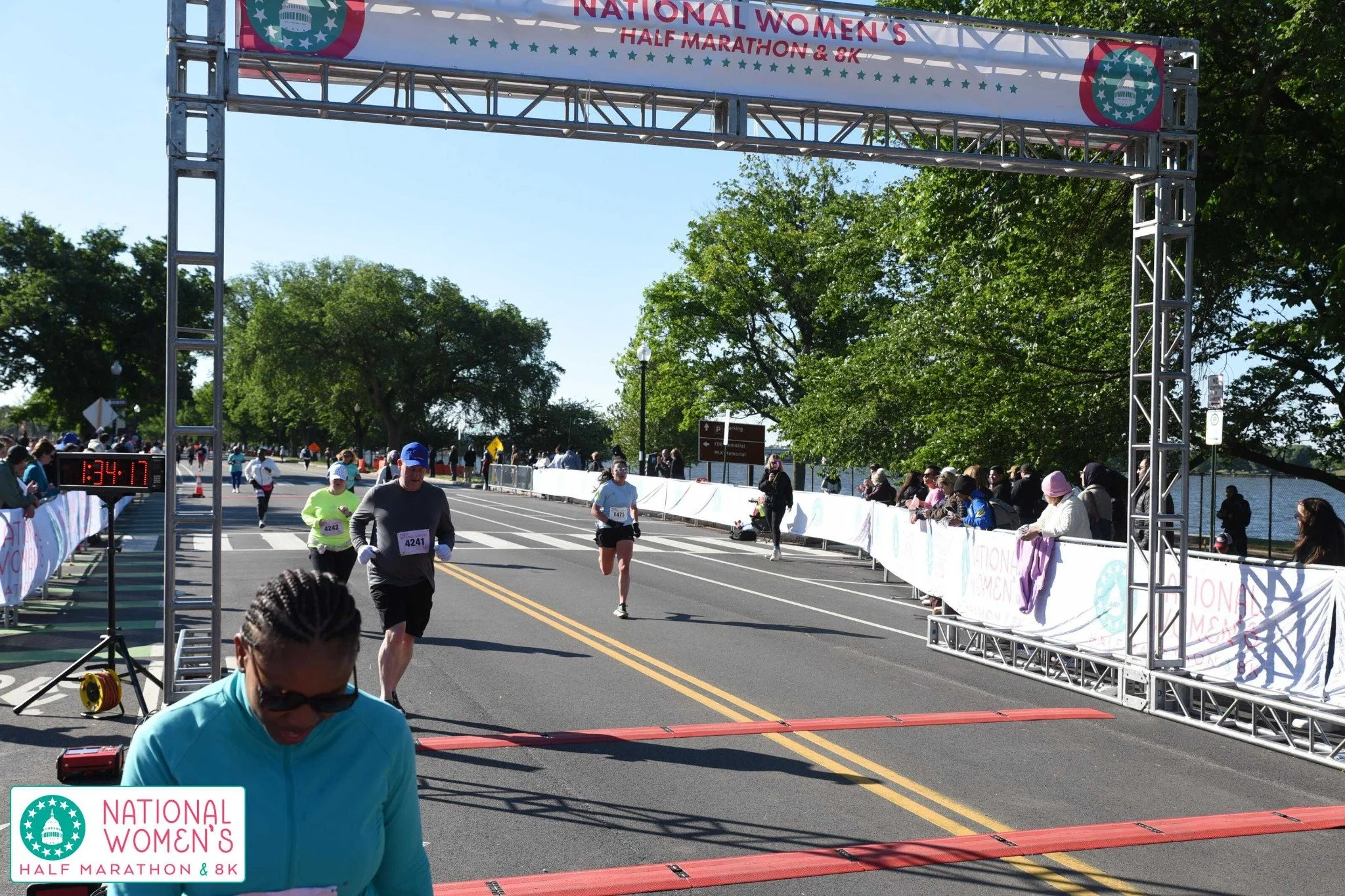
2026 National Women’s Half Marathon - PR of 1:34
In May 2026, I ran the National Women's Half Marathon in Washington, D.C. It was my second half marathon, and I finished in 1:34:28, averaging 7:07/mile. A PR. I was thrilled! I also made a near-perfect example of how not to start a half marathon. Let me set the scene.
It was around 45 degrees that morning. I was cold. I did a little stretching, some high knees, moved around a bit, and basically decided: I'll just warm up “during the race.” Famous last words!
Then the gun went off. The race wasn't huge, and suddenly I found myself running near the lead pack. And it felt GREAT. There's something deeply dangerous about the combination of fresh legs, race-day adrenaline, and seeing fast people directly in front of you.
My first mile? 6:44. Second? 6:46.
For reference, I would ultimately average 7:07/mile.
But there I was, two miles into a 13.1-mile race, apparently under the impression that I had become a significantly faster runner overnight.
Then I looked at my heart rate.
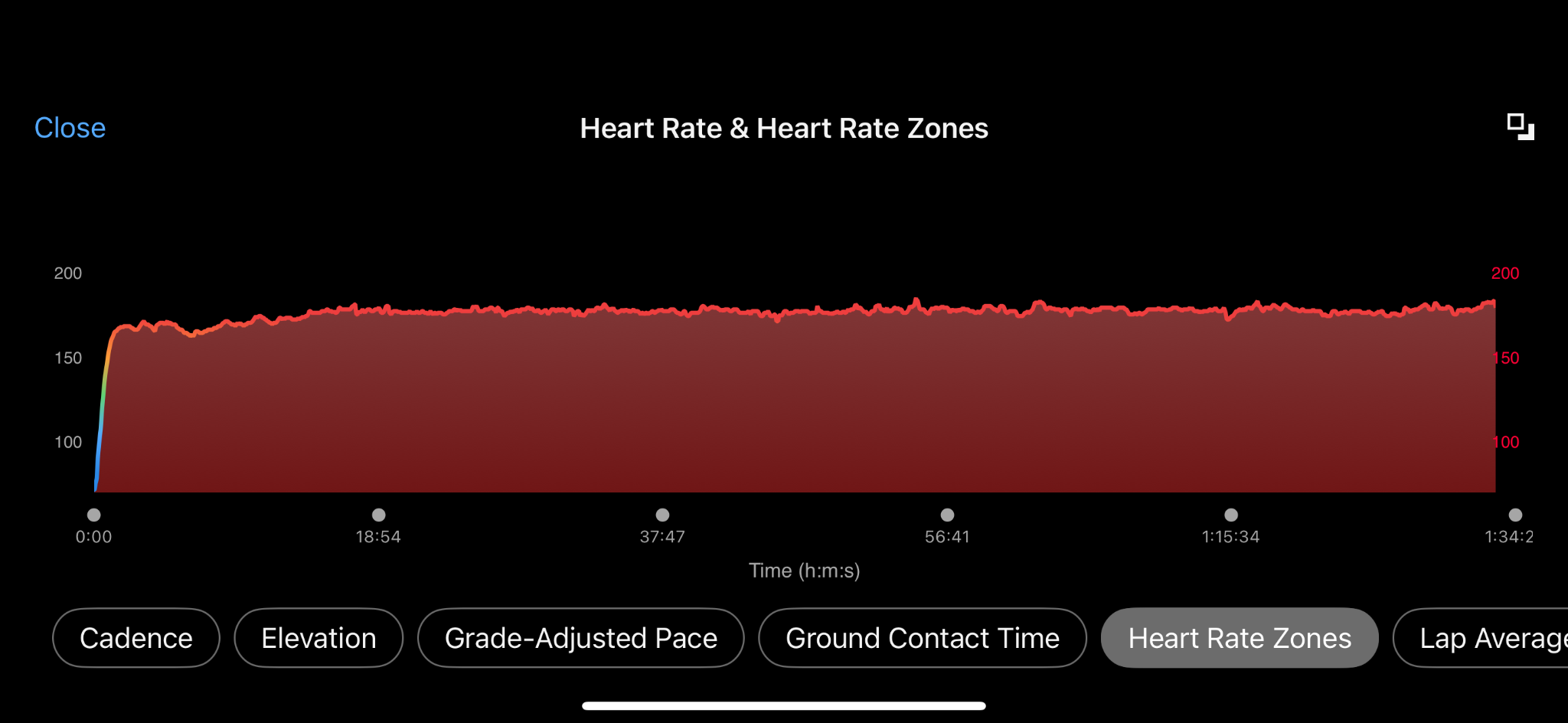
HR in the red zone 99% of the race! Eeeek
It shot up almost immediately:
Mile 1: 161 bpm
Mile 2: 171
Mile 3: 178
And then something interesting happened.
It basically never came back down.
Miles 3 through 13 averaged roughly 177-179 bpm. My average HR for the entire race was 176, with a max of 186.
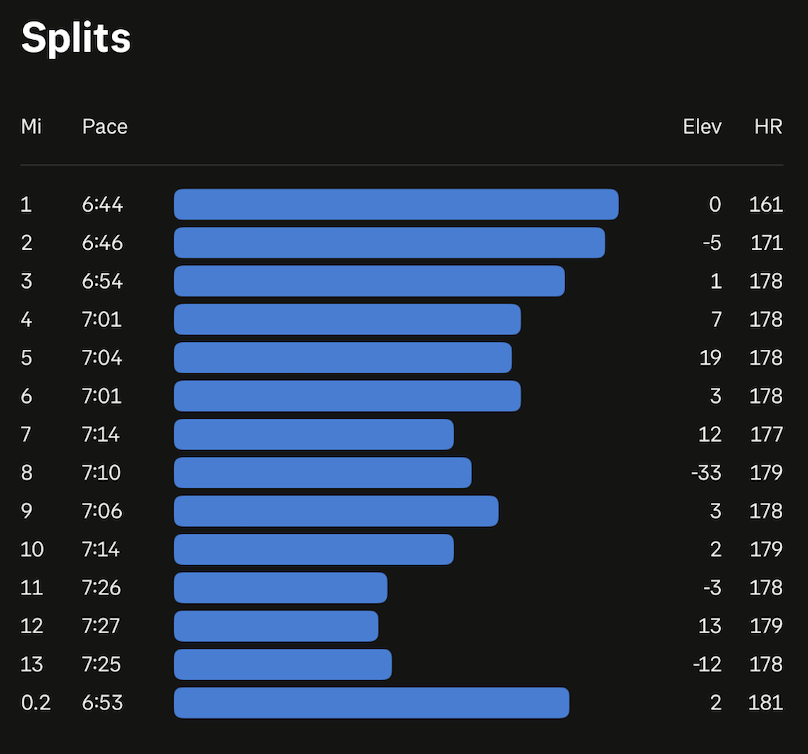
On a positive note - here are my splits…
My pace told the other half of the story:
Miles 1-3: 6:44, 6:46, 6:54
Miles 4-6: 7:01, 7:04, 7:01
Miles 7-10: 7:14, 7:10, 7:06, 7:14
Miles 11-13: 7:26, 7:27, 7:25
I didn't blow up spectacularly.
I just slowly paid back the loan I took out during the first two miles.
And the interest rate was quite terrible.
So what actually happened?
There are two separate lessons here: I wasn't properly warmed up, and I went out too fast.
Those are related, but they aren't the same thing. When you begin exercising, oxygen demand in your working muscles rises rapidly. Your cardiovascular system has to increase heart rate, stroke volume and blood flow, while local metabolic processes increase ATP production to meet the new demand. Those systems respond quickly. But not instantaneously.
A progressive warm-up begins that transition before the race starts. Muscle temperature increases. Blood flow increases. Oxygen delivery and utilization ramp up. The nervous system gets rehearsals at faster movement. You arrive at the starting line physiologically closer to the state required for racing instead of asking your body to make the entire transition after the clock starts.
The broader warm-up literature generally supports this. A systematic review found performance improvements following warm-ups in 79% of the performance measures studied.
But here's the part runners sometimes miss: A warm-up prepares you to race. It does not protect you from bad pacing.
Even if I'd completed the world's greatest warm-up that morning, running the opening miles significantly faster than my sustainable half-marathon effort still would have cost me.
"But I felt amazing."
Of course I did. It was mile one. This may be one of the most important pacing lessons I've learned:
Feeling good early in an endurance race is not evidence that you're running the correct pace. You're supposed to feel good early.
Your legs are fresh. Glycogen is plentiful. Fatigue metabolites haven't accumulated much yet. Core temperature hasn't risen substantially. Musculoskeletal fatigue is low. Your brain is excited. The crowd is excited.
And the finish line is twelve miles away. The question isn't: "Can I run this pace right now?" Obviously you can. You're doing it. The better question is: "What will this pace cost me later?"
That's racing.
The first mile shouldn't prove your fitness.
This is where restraint becomes a performance skill. There is no medal for winning the first mile of a half marathon. For most recreational runners chasing a PR, the goal should usually be a controlled, relatively even race rather than banking a bunch of time early and hoping to survive.
The research backs the general principle, although pacing is more nuanced than "negative split everything." A recent systematic review found no single imposed pacing strategy universally superior across endurance events, reinforcing that pacing should be individual and event-specific.
But observational data consistently gives us another useful clue: the runners who fade the least tend to perform better. Research on championship half-marathon racing found that the best men and women largely maintained their speed from 5K through 15K, while slower performers began losing speed earlier. And in a huge analysis of nearly 79,000 Boston Marathon finishers, even pacing was associated with faster finishing times, while major positive splits were associated with substantially slower performances.
Translation: Banking time isn't free.
You're usually borrowing it from your future self. And she will come collect!
So...how much should runners actually warm up?
Here's where race distance matters. The shorter and faster the race, the more important a substantial warm-up becomes.
Why? A 5K doesn't give you much time to ease into race intensity. If you're actually racing it, you're operating at a very high fraction of your aerobic capacity almost immediately. A marathon is completely different. Your race pace is substantially below the intensity of a 5K, and wasting glycogen and adding unnecessary fatigue before running 26.2 miles makes little sense.
So I think about it roughly like this:
5K: 10-20 min easy running + dynamic mobility/drills + 4-6 short strides
10K: 10-15 min easy running + dynamic movements + 3-5 strides
Half marathon: 8-15 min very easy running + dynamic movements + 2-4 short strides
Marathon: Minimal. Walking/light jogging + dynamic movement. Save the legs.
Obviously, these aren't laws. A highly trained runner, beginner, masters athlete, cold-weather race and hot-weather race may all require different approaches.
The principle matters more than the exact number of minutes: The closer your race intensity is to your upper physiological limits, the more valuable a progressive warm-up becomes! And a warm-up should make you feel ready, not tired.
That's also why I wouldn't spend 20 minutes doing long static stretches immediately before racing. Dynamic movement and progressive running generally make more sense immediately before performance. Research comparing pre-exercise approaches has found prolonged static stretching can negatively affect some measures of explosive performance, while evidence does not suggest it improves running economy.
My race-day warm-up now looks much different.
For something like a half marathon, I'd rather arrive early enough that I don't have to choose between warming up and finding a bathroom.
I'd jog easily. I'd use dynamic movements that take my hips, ankles and legs through the ranges I'll actually use. I'd throw in a few strides, progressively building toward race pace or slightly faster without turning them into mini intervals. Then I'd keep moving enough to stay warm before the start.
And when the gun goes off? I don't RACE everybody around me!
I race MY plan.
My favorite pacing rule: make mile one boring.
Race starts are weird. Everyone suddenly believes they're 20 seconds per mile fitter than they were yesterday. GPS watches are bouncing around. People who have absolutely no business running your goal pace are sprinting past you. The music is blasting. Your adrenaline is through the roof.
Let them go.
Especially in longer races, I'd rather have an athlete finish mile one thinking: "Was that a little too conservative?"
vs "Wow, I feel AMAZING. Maybe today's the day I run a pace I've never demonstrated in training."
The second thought has destroyed many perfectly good race plans. For a half marathon, I generally like the first mile controlled, then settling into goal effort and letting the race gradually get harder rather than forcing it to be hard immediately.
Because effort should increase. Holding 7:00 pace at mile 2 and holding 7:00 pace at mile 12 are not remotely the same task. That's the point.
The funny part? I still ran 1:34:28 - I still PR'd. That's why race results can sometimes lie to us.
A PR tells you that you ran faster than you ever had before. It doesn't necessarily tell you that you executed the race well. And those are very different things.
I look back at this race and don't think, What a disaster.
I think: There was probably more there.
Maybe I couldn't have run faster. We can never rerun the experiment. But I would love to know what would have happened if I'd properly warmed up, let the lead pack disappear, opened around sustainable goal pace, and made myself earn the right to start pressing later.
Instead, I ran 6:44 for mile one and 7:25 for mile thirteen.
The data doesn't need much commentary.
If you're racing soon, remember this:
Warm up before the race, not during it.
Don't confuse adrenaline with fitness.
Don't let somebody else's pace choose yours.
Feeling incredible at mile one is normal.
Your goal isn't to run the fastest first mile you can survive. It's to run the fastest entire race you can sustain.
*And maybe most importantly:
Patience is a race skill.
Sometimes the smartest thing you can do when the gun goes off is let people pass you.
You'll have plenty of time to see them again.
