Former Athlete Brain Series:
The strange identity crisis of life after college sports, and learning to find your identity in something that doesn't change when the season ends.
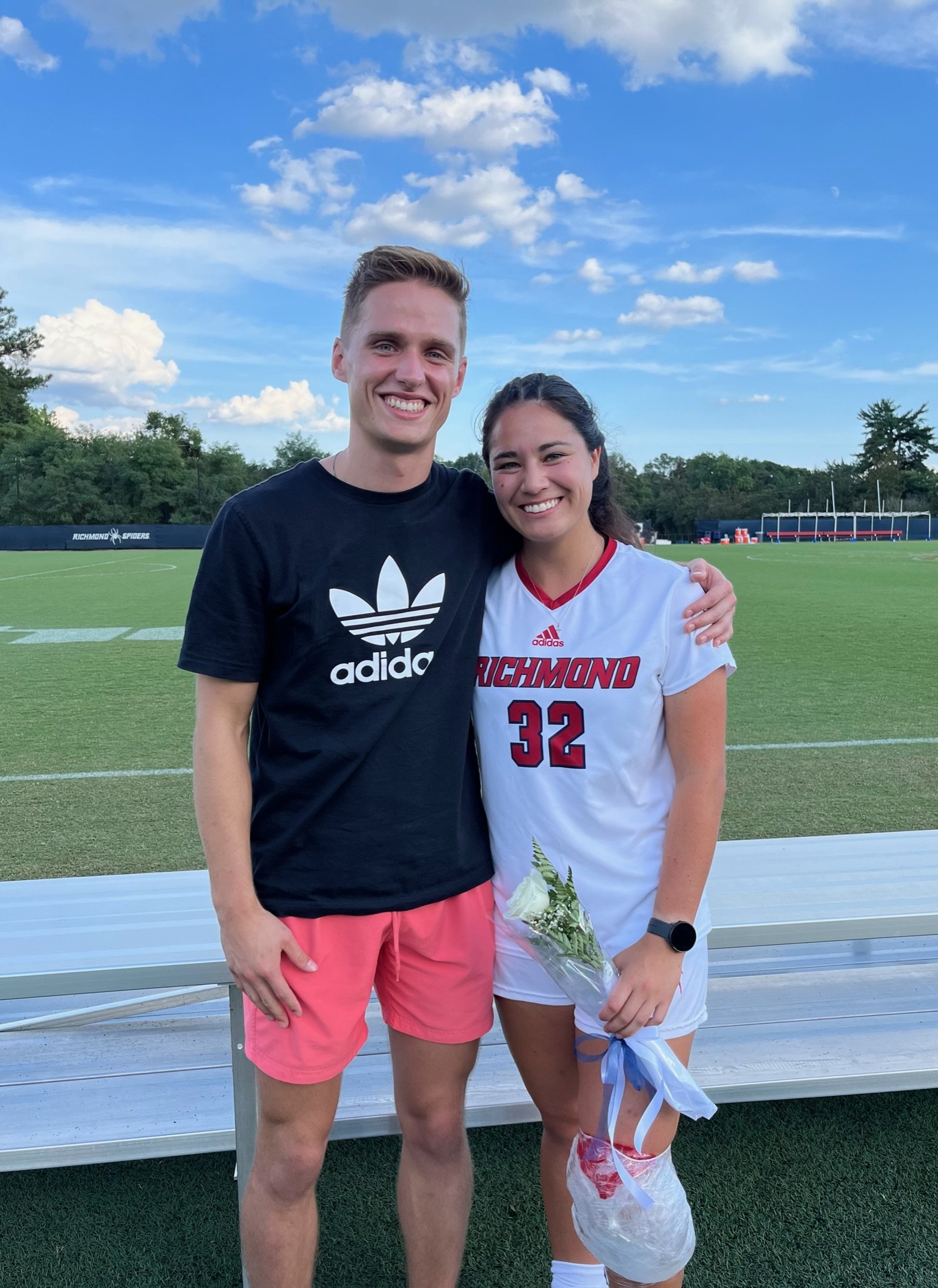
Senior Day | Fall of 2022 | w/ Ryan (just dating at that point)
I don't remember walking onto the field for my last college soccer game knowing it would be my last - because I didn't. It was sometime during my junior season. Just another game in a career that, as far as I knew, wasn't finished yet. But it actually was. You don’t “plan” for injuries, an element of the game which has a way of surfacing at the least convenient times.
The following fall, I was still recovering from a major knee surgery. I wasn't cleared for contact yet, but I could pass the ball. And on Senior Day, my coaches allowed me to take the opening kickoff before subbing me off the field to a clap-off. And that was it! Years of practices, conditioning, tournaments, injuries, early mornings, recruiting, and working toward the dream of playing Division I soccer.
And suddenly, it was over.
No final competitive moment where I got to leave everything on the field. No real opportunity to recognize that this was the last time while it was actually happening.
I think that's one of the strangest things about endings. Sometimes you don't realize you've experienced your last something until it's already behind you. And nobody really tells you what happens after that.
You don't just lose a sport. You lose an entire way of life.
I don't think there's anything quite like being a Division I athlete. As a kid, you start playing a sport because it's fun. You love the game, you love competing, and somewhere along the way, someone tells you that you might actually be good enough to play at the next level.
If you just work a little harder.
So you do. You train more. You get stronger. You travel for tournaments. You sacrifice weekends. You spend years organizing your life around the possibility of earning an opportunity that only a small percentage of athletes ever get.
And then it happens…You're a Division I athlete! Everyone tells you how incredible the experience is going to be. And it is incredible. But it's also probably nothing like you imagined. Because college athletics is not just playing the sport you love. It's literally a 20+ hour/week job, a commitment, a lifestyle, and sometimes a complicated relationship with something that used to be relatively simple. There are early morning lifts. Practices. Fitness sessions. Film. Recovery. Travel. Games. Classes. Studying. More training.
You eat, sleep, and organize your schedule around becoming the best athlete you can possibly be.
AND you're surrounded by people doing the exact same thing. There's something pretty special about that. You don't have to explain to your teammates why you're exhausted. They're exhausted too. You don't have to explain why a game matters so much. They understand. You have shared goals, shared sacrifices, and a built-in community of people pursuing something together.
And for years, that becomes your normal!
I didn't realize how much of my life had been organized around soccer until soccer stopped organizing my life.
The complicated relationship nobody talks about enough
Here's something I think deserves more attention. You can love your sport and still recognize that it took things from you. You can be grateful for your college athletic experience and still have complicated feelings about it. You can miss something that was also incredibly difficult. Over four years, the sport you once played simply because you loved it can become something much more complicated.
Maybe you deal with injuries, surgeries, and countless hours of rehabilitation.
Maybe your relationship with your body or food changes.
Maybe the pressure to perform starts affecting how you see yourself.
Maybe you become so accustomed to evaluating your worth through athletic performance that you don't even recognize you're doing it.
And then one day, the whole thing ends…The schedule disappears; The games stop; The team moves on.
And you're left trying to figure out which parts of yourself were genuinely you and which parts were built around the demands of being an athlete. Something I’ve reflected on is the fact that we don’t talk about that transition enough…. We spend years helping young athletes prepare for the next level. Club soccer —> High school —> Recruiting —> College —> maybe pro? There's always another goal. But what about preparing them for what happens when there isn't another season?
And perhaps an even bigger question:
If so much of your identity has been built around something that can end, what happens to your sense of worth when it does?
Nobody is telling you what to do anymore.
This might have been the strangest adjustment for me. I missed the schedule. Which is funny, because when you're in the middle of college athletics, you're constantly wishing you had more free time! Then suddenly you have it. And you're forced to sit in this weird space… almost like a sort of “discomfort of comfort”... “Okay. Now what?”
For years, almost every decision in my day had some relationship to becoming a better soccer player. When to train. When to lift. What to eat. When to recover. How to spend my time. Even the things I did outside of soccer were often organized around soccer. There was always a reason behind the regimen. A season to prepare for. A starting position to compete for. A championship to pursue.
Not sure if I was a bit on the extreme end or not (that’s a conversation for a different day), but it is no exaggeration that I structured my life to the minute around specific goals - i.e. in school and soccer. *We are focussing on the soccer/athlete part of that today.
And then, almost overnight, a central goal was gone. Nobody was programming my workouts. Nobody was expecting me at practice. Nobody was telling me when to show up, what to work on, or how my performance measured up. At first, that sounds like freedom. And in some ways, it is. But when you've spent most of your life operating within a highly structured system, that much freedom can feel incredibly uncomfortable.
I had spent years learning how to become a better athlete. I hadn't spent nearly as much time learning how to just be a person.
Or maybe more accurately, I'd spent so much time developing one part of myself that I hadn't given nearly as much attention to who I was outside of it.
So naturally, I tried to replace it. I think this is where my former-athlete brain really showed itself. I was so accustomed to being busy, disciplined, and constantly working toward something that I tried to recreate that same intensity in other areas of my life. I threw myself into work, exams, professional licenses, new goals, new challenges. And eventually, one of those challenges was running.
The point is though, there was always something else to accomplish. Something else to improve. Something else to work harder at. But I started realizing something important: Being busy isn't the same thing as having purpose.
I knew how to fill a schedule, how to work hard, how to push myself. What I was less comfortable with was slowing down long enough to ask why I was doing all of it. In college, the why was usually obvious. Become a better soccer player, help the team win, and compete at the highest level. After college, the answer wasn't automatically handed to me anymore. And I think that can be a difficult adjustment for people who have spent their whole lives chasing clearly defined goals.
Because when you've spent years measuring progress, it's uncomfortable to enter a season where progress looks different. Or where you haven't figured out what you're progressing toward yet. Looking back, I think part of what I was learning was that I could be incredibly disciplined about pursuing a goal without necessarily being grounded in something deeper than that goal. And those are two very different things.
You can't recreate the exact thing you lost.
One thing I've had to accept is that nothing will ever feel exactly like being part of an elite college athletic team. And that's okay. But it took me a little bit to stop comparing everything to it. Playing in Sunday adult league isn't the same as competing at the Division I level. Working out on your own isn't the same as training with teammates who are all working toward the same playoff game. And signing up for a race is NOT automatically going to recreate the experience of being part of a college program.
It's not simply that “soccer is soccer” or “sports are sports.” The environment matters. The people matter. The level of competition matters. The shared commitment matters!
I think sometimes we make the mistake of trying to recreate an old chapter of life instead of appreciating it for what it was. We compare new experiences to something they were never meant to replace. And then we're disappointed when they don't feel the same. But maybe they aren't supposed to! Maybe the goal isn't to find something that feels exactly like the old thing. Maybe it's to make room for something different. And maybe part of growing up is learning to trust that just because one season ends doesn't mean your purpose ends with it.
And then I started running.
Initially, running was pretty simple. I wanted to stay in shape. It was convenient. I could hop on a treadmill or run around the neighborhood without coordinating schedules, finding a field, or needing a team. No complicated plan or competitive objective. Just running. But in September 2024, my sister and I signed up for my first marathon, and I think I caught some kind of bug.
Suddenly, there was a big goal again - a challenge that required preparation, discipline, and a willingness to be uncomfortable. There was something to work toward, and I loved it. Not because running was soccer - It definitely wasn't. But because it reminded me that the part of myself that loved competing, improving, and pursuing difficult things hadn't disappeared. It had just found another outlet.
Of course, I also learned that being a competitive former soccer player does not automatically make you a knowledgeable marathon runner. Apparently, you're supposed to consume carbohydrates and water during a marathon. A lesson I learned the hard way. But that's another story.
The bigger lesson was that I could become a beginner again! I could learn a new sport and set goals that belonged to me. And I could carry the discipline and competitiveness I'd developed through soccer into something completely different. I hadn't stopped being an athlete just because I stopped playing college soccer. But I was also beginning to understand that being an athlete was only one part of who I was. And as much as I love running now, I would be a fool to make the same mistake of building my entire identity around another sport. Because running is a gift, just like soccer was. And I want to enjoy that gift, work hard at it, and use it well without asking it to give me something it was never meant to provide: an unchanging sense of worth.
Former athlete brain doesn't just disappear.
There's one thing I will say about transitioning from a team sport like soccer into endurance running. You have to unlearn a few things. In soccer, so much of training and competition requires explosive efforts, quick decisions, and the ability to respond at full speed. And when you've spent years hearing that you need to give 110%, that mindset gets pretty ingrained. Then you start distance running. And suddenly your training plan tells you to run easy. Easy? As in... intentionally not go as hard as I can? Interesting concept. For a while, I had a tendency to turn every workout into some kind of test. Could I go faster? Could I push harder? Could I do more? But endurance training doesn't reward that mentality every single day. Sometimes the smartest workout is the one where you deliberately hold back. Sometimes progress requires recovery. Sometimes doing less today allows you to do more tomorrow. And that has been a surprisingly important lesson beyond running.
Just because you know how to work hard doesn't mean you always know when working harder is the right answer.
Discipline is valuable.
Competitiveness is valuable.
The willingness to do difficult things is valuable.
But those qualities need DIRECTION. Otherwise, you can spend a whole lot of energy being extremely disciplined about things that aren't actually moving you toward what matters. And for me, learning to trust God with my future also means accepting that I don't have to force every season of my life to look productive by my own definition.
I can work hard at what's in front of me without needing to control exactly where it leads. Which, for someone who loves a good training plan and a measurable goal, is still very much a work in progress.
Now with all of that, what exactly would I tell my younger self? Or any athlete facing their final season?
Move on over to Part 2 - the next blog post!
If you're a current or former athlete who's experienced this transition, I'd love to hear your story. What did you miss most? And what helped you find your footing afterward?
And if you're a runner looking for a coach who cares about the person behind the performance, I'd love to connect. I believe running can be an incredible tool for growth, but it should never be the only thing that defines us.
